
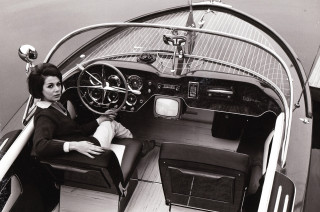
Rio boats were handcrafted between 1960 and 1975 in Sarnico on Lake Iseo in Italy. The entire hull was crafted in a single piece from mahogany wood that was laminated multiple times and finished with 22 layers of varnish. These were built entirely in the company’s own shipyard, unlike competitors’ boats, which were assembled from prefabricated parts. Only just under 500 units were ever produced. This makes every boat truly one of a kind.
They hardly differ at all. The two shipyards were located close to each other. The founders, Dr. Luigi Scarani and Carlo Riva, were friends and collaborated on various projects, including the purchase of V8 engines from the U.S. Over the years, employees moved between the companies, and they inspired one another. Consequently, the design of most boats is nearly identical.
Both construction methods are of the highest quality, but differ in their technical solutions: Riva uses a three-layer planking on the sides - two layers crossed at a 45° angle (structural laminated wood) that resist deformation, and a final longitudinal layer of solid mahogany that serves both structural and aesthetic purposes. Rio, on the other hand, uses a base of stabilized marine plywood onto which a longitudinal mahogany veneer is applied: a “more modern” solution that is very rigid and less prone to warping over time.
As for the frame construction, Riva distributes the frames variably, with a shorter spacing toward the bow - the part of the boat subjected to the greatest stresses - while the spacing is greater toward the stern. Rio, on the other hand, maintains a more uniform frame arrangement along the entire length to achieve more consistent structural stiffness. The stringers also differ: Rio uses three main stringers, while Riva uses four (two per side).
When underway, the Rio Colorado features a more pronounced V-shaped hull, which allows for better wave absorption and greater course stability at high speeds. The Aquarama, with its relatively flatter hull, offers a smoother, more planing-friendly ride, but may be less effective in rough seas.
Rio built six different models: the single-engine Espera, Bonito, Real, Paranà, and Rolls-Rio, as well as the twin-engine Colorado as the crowning jewel. The Colorado, with two V8 Chris-Craft engines delivering up to 390 hp each and a length of 8.45 meters, is considered the flagship. It hit the market a year earlier than the structurally identical and equally legendary Riva Aquarama. Only the stern and the instrument panels of the two classics differ.
Top-restored examples range in price from five to six figures in euros. The Rio Colorado is currently available for €249,000, and the Rio Espera for €124,000—both in top condition, including VAT, and with a fully documented restoration history.
The American V8 engines from Chris-Craft and Chrysler are among the iconic powerplants of classic boatbuilding from the 1950s to the 1970s. They combine a powerful sound with high reliability and are an essential part of the distinctive driving experience of that era. All of our boats for sale are equipped with their original engines.
A fully restored Rio boat is absolutely ready to sail and is definitely intended for use on the water—it is not a museum piece. At the same time, it represents a stable investment and belongs to the category of “passion assets,” such as classic cars or works of art.
A professional full restoration includes woodwork, electrical systems, engine overhaul, refurbishment of all chrome parts and fittings, as well as the fabrication of a new canopy and upholstery. The process typically involves several hundred hours of manual labor and is documented over the years—which significantly increases the boat’s value.
Yes. Rio Classic Boats handles the sale confidentially—from the condition report and valuation to marketing to pre-qualified prospective buyers worldwide. This protects both the seller and the buyer.
The club connects owners and enthusiasts of classic Rio mahogany boats worldwide. It offers information exchange, a global boat directory, and invitations to exclusive events. The club is a revival of an association of the same name that existed on the Côte d’Azur between 2006 and 2016.
Rio Classic Boats offers private viewings by appointment on Lake Garda in Bardolino. Due to the exclusive nature of the properties, we recommend contacting us directly via our website.
.
Classic mahogany boats from this era—especially Rio and Riva—have proven to be assets that appreciate in value over the past two decades. Their limited production, artisanal origins, and the cultural significance of the “Dolce Vita” era make these boats highly sought-after collector’s items.